

What follows is an argument. This is an argument that I have often, in many contexts, but it always begins as a definitional argument. When we use certain terms, what do we mean?[i] Much has been written recently about the importance and desirability of sustainability in the watch industry. What does it mean to buy a sustainable watch?[ii]
The United Nations defines sustainability as “the integration of environmental health, social equity and economic vitality in order to create thriving, healthy, diverse and resilient communities for this generation and generations to come. The practice of sustainability recognizes how these issues are interconnected and requires a systems approach and an acknowledgement of complexity.” There is a lot to unpack there, and I really don’t want to write a jeremiad on all of its wrongness. Let’s just paint me skeptical of the newspeak.
It is important to note that all discussion of sustainability assumes that there are finite resources. This is a Malthusian conceit. It seems that no one remembers the bet that business professor Julian Simon made with famous Malthusian biologist Paul Ehrlich. Simon allowed Ehrlich to select the raw materials that he believed would become the most scarce in the decade of the 1980’s due to overpopulation and overexploitation. Ehrlich chose tin, chromium, copper, tungsten, and nickel. The measure of success for the bet was whether those commodities increased in value relative to inflation. Simon won the bet because each commodity decreased in value relative to inflation, and three of them decreased in real dollar terms. Simon bet on human ingenuity to overcome material scarcity.
I sit on the boards of both governmental and private organizations that are trying to build and maintain affordable and work-force housing in my increasingly expensive small city. Public housing has been a keen interest of mine since college. I would drive dates through the projects of New Orleans and point out the problems that I could see from a design and maintenance perspective. (Yes, I must have been considered quite a catch.) This is before the scattered site innovations that transformed much of what we now know as public housing. On some of these boards there are community leaders, bankers, architects, and developers. I am usually the only lawyer, and a criminal defense attorney at that. When we build new housing or rehab existing stock invariably the architects will try to sing the siren song of sustainability to us. Every time that we listen, every time, the system that we install, whether HVAC or roofing or exterior, encounters cost overruns and breakdowns. These systems do not last as long as conventional systems (for now). Sustainable means more cost in construction and maintenance. I have a fiduciary duty to these organizations and the citizens they help to provide the best product and the biggest impact for our limited funds. I am often at odds with the planners and architects. I want to house people, not save the planet. I have unusual libertarian tendencies for a public housing advocate. Only when sustainable products prove themselves in the market should they be considered.
Most watches that claim to be sustainable use recycled materials of some sort: plastics from the oceans or steel from wherever. Recycling is an opaque industry. The Manhattan Institute recently released a white paper on the economic sense of continued municipal recycling.[iii] After China instituted Operation National Sword in 2017 and stopped the importation of foreign materials for recycling many cities and towns in the United States and Japan began to lose money on the process. The transportation and collection costs were simply too high. A local suburb here was in the news when it was revealed that collected recycling materials were being dumped at the same landfill as other waste. The town explained that a local processing plant had shuttered and it was no longer economically feasible to ship the material for further processing. For more than two years the town quietly let citizens continue to sort plastics and paper all for no reason.
Insofar as watch brands are using recycled materials it is safe to say that the source of these is most likely China. (Some sustainable watch brands use wood for cases. If that is right for you, by all means purchase and enjoy them, just know that the battery in the movement is going to a landfill sooner than those in other watches. Wooden watches break fairly easily compared to other materials.) It is probably a good thing to use China’s recycled materials. The primary source of plastics in the ocean is the Philippines with nearly three times the amount of waste as the next country, India. China is fourth in total ocean plastic pollution. If some of it is diverted to a watch strap or case than that is unquestionably good.[iv]
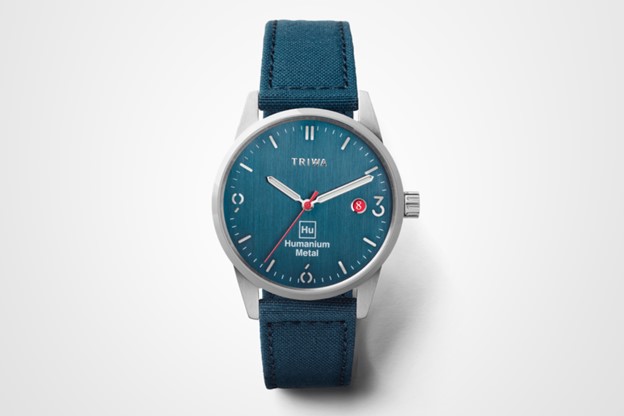
Many of the watches on any sustainable list are made mostly or wholly in China. Let’s take Triwa for example. They are designed in Stockholm, but they were always very cagey about where the watches were actually manufactured. It took an interview of one of the founders with the niche journal Retail in Asia before they admitted that their watches were made in China. An interesting wrinkle however is Triwa’s Humanium watch that is made from the recycled steel of illegally possessed weapons. Where was that material sourced? Probably not Sweden. I would feel better if it was. An illegal weapon seized in an authoritarian state has a slightly less noble ring to it.
Do we really know that these watches meet the promise of sustainability? These watch websites are written in platitudes while production is turned over to the world’s biggest polluter. What is a watch consumer to believe?

What if I told you though that there is a way to buy a truly sustainable watch? You don’t need to worry about battery disposal or rare earth mining. Everything is recycled, except the strap, and you can source recycled straps fairly easily. You may have heard of the mysterious world of “Vintage” watches. Movements and parts have already been manufactured, sometimes many decades ago. No need for the energy required to reforge steel or other metals. Maybe just a polish will do. There is an added bonus of supporting the skilled craftsmen who have made the watch industry what it has been for several centuries. Think about it before you buy recycled from China. Think global, buy local.[v]
[i] I am not going to suggest that you ever read anything by Ayn Rand. She was a contemptable person in her private life and her prose and plotting are both leaden and jejune. However, her characters all insist on defining their terms. For this she no doubt borrowed from others realizing the importance of language in politics, most notably George Orwell, Politics and the English Language (1946).
[ii] I am tempted to put quotation marks around the term sustainable. I will resist.
[iii] Husock, “The Declining Case for Municipal Recycling” (2020)
[iv] Here is the list for those keeping track: 1. Philippines, 2. India, 3. Malaysia, 4. China, 5. Indonesia, 6. Myanmar, 7. Brazil, 8. Vietnam, 9. Bangladesh, 10. Thailand. Numbers 2 and 3 pollute the oceans more than all countries not on this list combined. Southeast Asia has a pollution problem that is not on the same scale as places like the United States, Canada, Australia, or the United Kingdom. Yet we buy the watches with recycled plastic.
[v] This is the slogan of the sustainable food movement. They don’t want you to eat avocados or pineapples (certain locations are exempt).

 The Escapement Room