

Upon reflection I realize that I know nothing. What little knowledge I had gleaned from the world of vintage watches could not fill a Chinese teacup. Whatever rules established by voracious consumption and vicarious living through enthused enthusiasts sharing their watch lives do not always translate to confident experience. Sizes. Goddamn sizes. Why are they so confusing?
Quite quickly I learned at the start of my watch obsession that size doesn’t matter. One of my first purchases was a 29mm Hamilton Endicott from the 1930s. Initially I felt self-conscious with it on my wrist, as if I’m wearing a girl’s watch. However, I got over it after a few days and small became my default. Size doesn’t matter. This unassailable “truth” would be verified by the voracious consumption I referred to at the start of this writing. Buy enough watches and you will quickly find your style and your ideal watch size. As such, small watches suited me. I preferred them. They were comfortable. They looked good on me. Additionally, the more I looked at fellow watch enthusiasts’ social media feed, living as I said vicariously through their seemingly endless online wrist shots, the more I was convinced that, yup, smaller watches just looked better. They were less obtrusive. Wrist presence need not mean big and chunky.
Now? I’m uncertain.
I remain convinced that I prefer small watches, that is until I don’t. Look, here’s a photo:
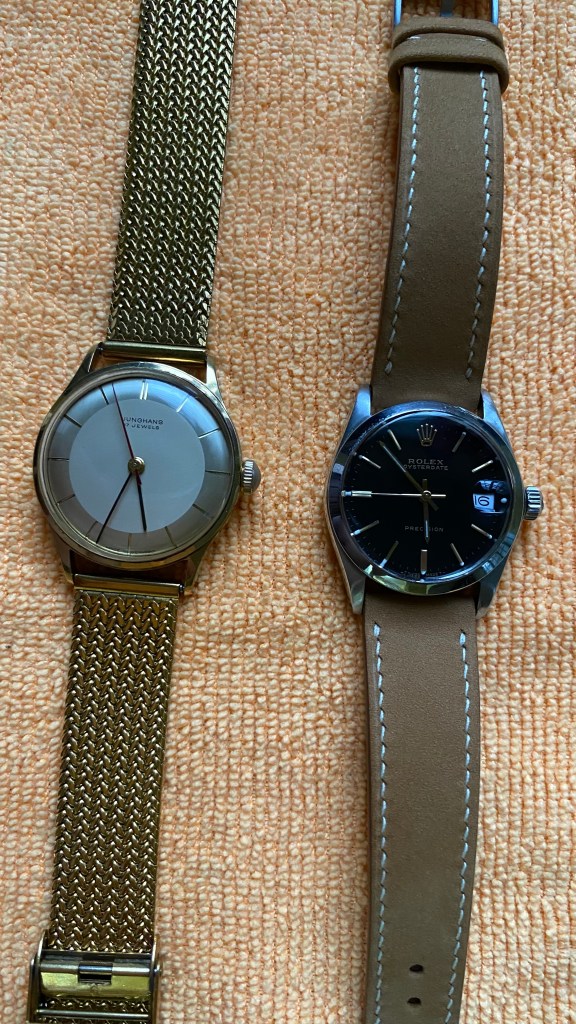
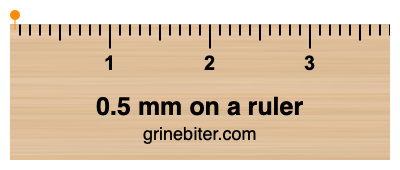
On the left is a 1960s Junghans and on the right is a 1959 Rolex Oysterdate. The Junghans has a 31mm case without the crown while the Rolex has a 30.5mm case diameter sans crown. A point five millimeters difference. Do you know what 0.5mm actually looks like? See the orange dot in the image below? That’s 0.5mm. In the grand scale of things, it’s nothing.
And yet, in the world of watches it’s significant enough that, somehow, the Rolex feels smaller on my wrist. Small to the point that sometimes it’s downright unwearable. I have no problems with the Junghans. I wear it without thinking about sizes and wondering whether it’s too small. With the Rolex, I’m constantly trying to reassure myself that it’s fine. The size is fine. I’m okay. It’s okay.
It’s really not okay.
30.5mm is not the smallest watch I own. I have a 1920s Seiko that’s 26mm. Right now it’s in a bundt that makes it seem bigger than its actual size but I can easily wear it without that. I have no problems with 26mm.
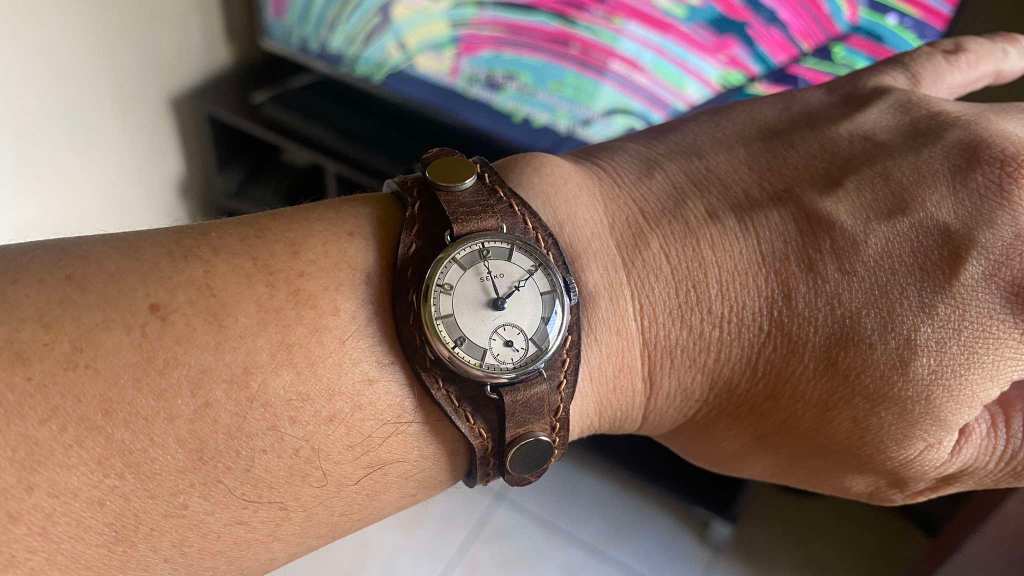
Yet the Rolex is just not fitting well.
The more seasoned watch wearer will tell you that it’s not the case diameter that matters but the lug-to-lug. I’m not talking about how it sits on my wrist though. the smaller the watch, the less likely we’re going to encounter problems like overhang. The Rolex fits fine. But also, it doesn’t? It just seems too small. Why it seems small I don’t understand.
At first I thought that perhaps it’s the dial to bezel ratio. If you look at the Junghans, it might bigger due to the diminutive bezel.
(Look, before we continue, let me just point something out. I realize that when we say bezel in the watch world, the image most of us think of is the rotating marked bezel that we often see on dive watches. Bezel can also mean the ring the surrounds the crystal. Not all watches have bezels, not all bezels rotate. There.)
Where was I before I rudely interrupted myself? Bezel. Right. In the Junghans, the bezel is thin, giving the dial bigger real estate. The bezel in the Rolex is thicker, making the dial look just that much smaller. It could be this. It probably also helps that the Junghans has a pie-pan dial whereas the dial on the Rolex is flat black. Although, if you think about it, the pie pan actually makes the center of the Junghans dial seem that much smaller, doesn’t it? I must be nuts.
Let me give you another comparison:
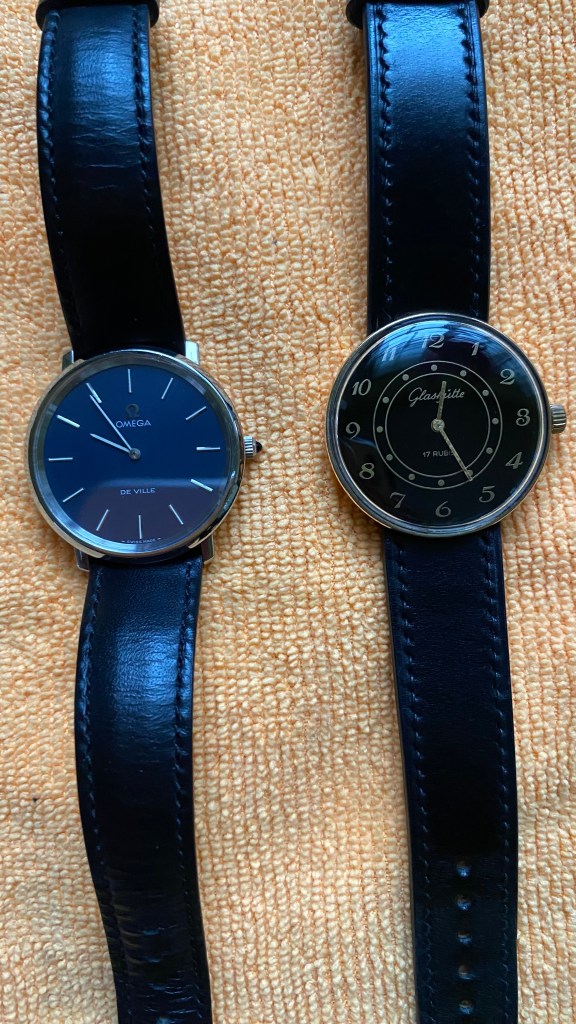
The Omega De Ville is 33mm and the Glashütte is 34mm. To me, they look like they could both be 33mm or 34mm. The De Ville does seem a hair smaller if I squint my eyes, possibly as a result of the steel bezel surrounding it. The Glashütte is truly bezel-less. I have no idea how the crystal is attached to that dial. In terms of how they both wear, they wear the same to me. The De Ville “feels” smaller but it’s also fitted with a 17mm strap versus the Glashütte’s 18mm.
However, if we’re using the thick-strap logic, then the Rolex should wear bigger with its 17mm lugs compared to the Junghans’ 16mm.
The Rolex is a head-scratcher. I do have an alternative theory to the bezel one but it’s not a very good one. I think it’s the Rolex brand. It demands to be bigger and obvious. I haven’t seen a lot of Rolexes in my life. But the few that I have seen have that je ne sais quoi identifier that make them Rolex. Is it the crown? Do you need to see it clearly for the magic to happen? Wrist presence need not mean big and chunky–I said this at the beginning, yes, I have not forgotten. Like I said, not a very good theory. Perhaps it’s the case. It just calls for it to be bigger, 34mm at the least. Here it is in its original Oyster bracelet:
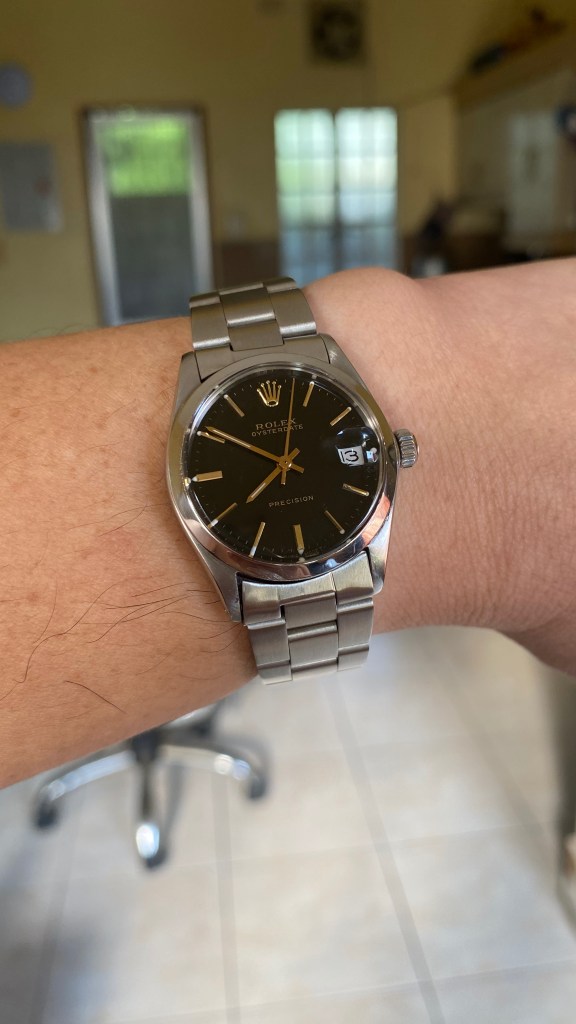
Do you see what I mean? It looks smaller than it should be, at least to me. I think that with the oyster bracelet it looks too much like a modern Oyster Perpetual that my mind is expecting modern size.
I’ve been reassured by my more fashion-forward female friends that it looks fine on my wrist. I remain unconvinced.
The Rolex hasn’t soured my preference for smaller watches. I think my sweet spot is 34mm and I so badly want this Rolex to be 34mm. But I do still love wearing watches that are smaller than that. I think the Rolex is the exception to the rule. Size does matter when it comes to Rolex. Or maybe I’m just imagining the dissatisfaction. All I know is, the size keeps it from being one of my favorites despite it costing a lot of money. You know what they say, your favorite won’t necessarily be the most expensive, another unassailable “truth.”
So, where do we go from here? Does the Rolex have a place in my collection? I don’t actually know. Maybe. Maybe not. Nothing is definitive in this hobby.

 The Escapement Room