
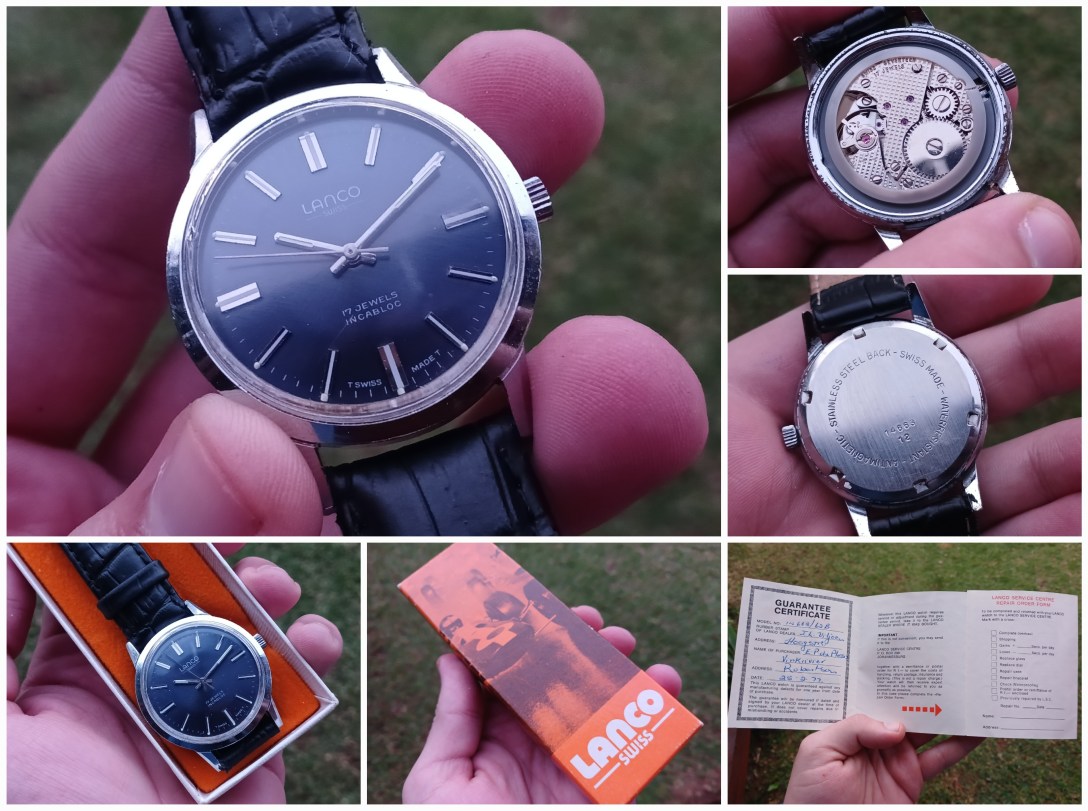
(Written May 2025)
I collect/hoard vintage watches. Very few people keep the box of a product for fifty years. Hell, few people keep the box for more than a week. This means that when you buy a vintage watch, ninety-nine times out of a hundred, you get the watch, no more, no less.
That being said, every now and again, you get that one.
That one for me was a basic, plain Jane, metaphorically beige Lanco. It was for sale on an auction platform that I am very active on. The watch wore an Expandro rally bracelet. I have one of those, and they are quite rare, so of course I “needed” to get another one. The watch was going for a price that tempted me more than Nomzamo Mbatha and a drum of baby oil, so I figured to buy the watch, remove the bracelet, put it on a new strap and sell it on to someone to break even or make a small profit.
Now that I type my plan out, it seems exceedingly stupid. Why did I need two of these bracelets again? Maybe I’ll sell one, because I have no reason beyond selfishness for having two, but then why did I buy the watch on the first place? I bought a watch for the bracelet, with the intention of selling the watch and then… selling the bracelet? Couldn’t I just have, you know, not bought the watch in the first place, especially considering it was coming out if my food budget? Quite a smooth-brain move on my part.
Normally, I would be worried about the watch not selling, but watches with boxes and papers tend to find new homes quickly. I attribute it to a placebo effect that buyers new to vintage watches have where a box and papers somehow signals that the watch was loved and cared for greatly. A box and the relevant papers are a good sign that a watch was looked after or had a discerning owner, but it by no means says anything conclusive. If I knew where to get some old boxes, I could just put abused watches in them and have some less experienced buyers think that they’re authentic and well-looked-after.
I could even be victim of that myself. The papers of my watch indicate this watch as a model 14663/62B. Running that through Google gives me nothing helpful. On more expensive or well-known watches, it’d be easier to verify that the papers match the watch. In fact, on a watch like this, papers aren’t used like that. All they do is tell the buyer that John Doe bought the watch at Arseballs Jewellers Pty Ltd on 12 July 1979. John Doe has likely passed away and Arseballs Jewellers likely went bankrupt.
My Lanco is a tiny bit exceptional in that regard. The shop that sold this watch still exists. It’s a family-run operation too.
That wraps up my quick Lanco hijink. I got the watch sold within a day of listing it and made a profit. I still have the bracelet. I think the new owner is happy. It may not be the best watch out there, but the fact that there’s a tangible paper trail is interesting in its own right.
It seems I have great success with Lancos. Of all watches I’ve sold, I’ve sold more Lancos than any other one brand.

 The Escapement Room