
Sounds like a Harry Potter book doesn’t it…
Despite the recent Seiko acquisition, and whatever else I’ve been moaning about, I did also start re-wearing this lovely little Fluva.
This is a little sweety, powered by a Felsa 690 Bidynator. Fluva is a brand trademarked in Geneva, 1949, by J. D. Klopmann. Klopmann also registered trademarks for Academy, Ambre, and Andromède in 1948. An M. Klopmann and Fluva Watch also trademarked Gondola in 1948. That’s literally it… absolutely nothing.
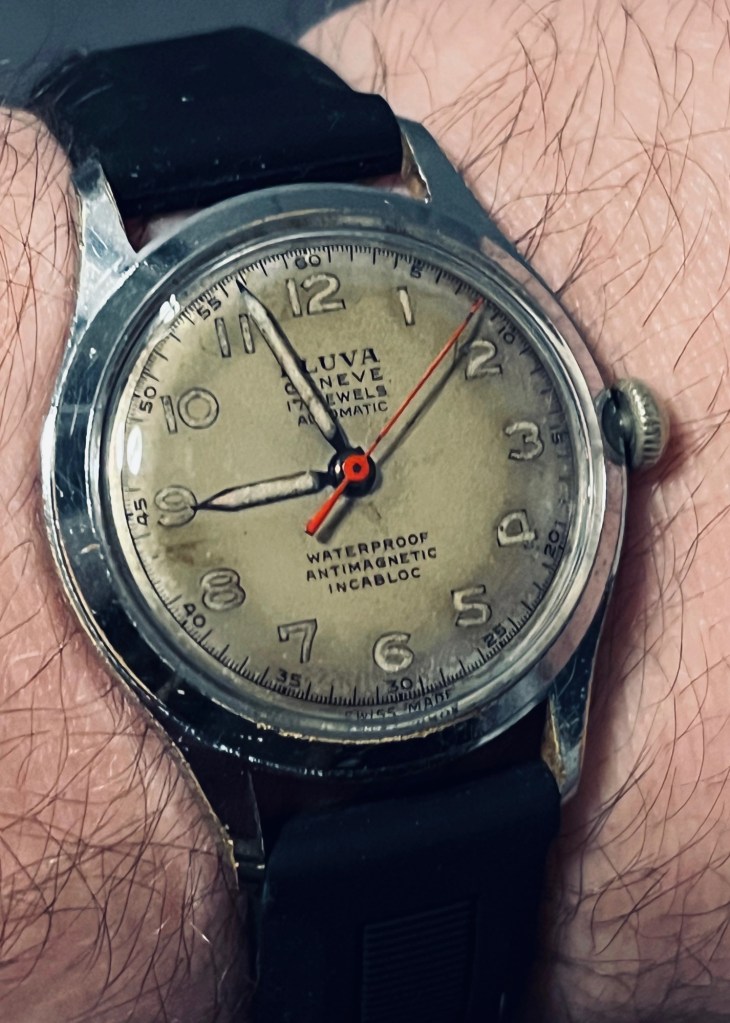
What is the watch… well it’s a 30mm (33mm with the crown – and that is a big button) military-inspired watch. The case is steel-plated with a stainless-steel back, so far, so common. It’s probably not that remarkable really.
The dial is very weathered. Despite no “Ra” or “T”, it’s clearly got radium-lumed sword hands, painted numerals with distinct levels of burn in a halo-pattern, and the dial (whatever the original colour was I have no idea) is this mustardy-yellow/green which makes everything on the hardware pop. In the right light, at the right angle, the numerals glow white hot… it’s almost eerie, but definitely cool. You can almost taste the rads. The sweeping seconds hand is painted red, and through collective ramblings on here can still date this to the 1940s.

Probably one of the most interesting things about the dial is the text… there is an entire thesis here, seven (7!) lines of information that makes most Rolexes seem illiterate. Fluva, Geneve, 17 Jewels, Automatic, Waterproof, Antimagnetic, Incabloc. All that’s missing is its star sign and occupation and then we have a full Tinder profile (yes, I’d swipe right). Despite the amount of text, its looks good. When Greg and I were discussing this watch many moons ago, I proposed that it might be because it was an early model and they wanted it to stand out in terms of what it brings to the table; he countered that an image search implied that Fluva were usually heavy of the wordage… No final argument was made, it just has a lot to say, and I think that’s perfectly acceptable. The text layout is relatively symmetrical, and it looks nice; it could have been a lot more offensive (Tudor take note yeah lads…).

The movement is probably the most interesting thing here, not going to lie. It has a Felsa 690 Bidynator. Quite a lot of random jobbers had Felsa Bidynators, it’s common as an early automatic, and I have it good authority it’s one of Greg ’s favourite movements. I can see why… silent but deadly.
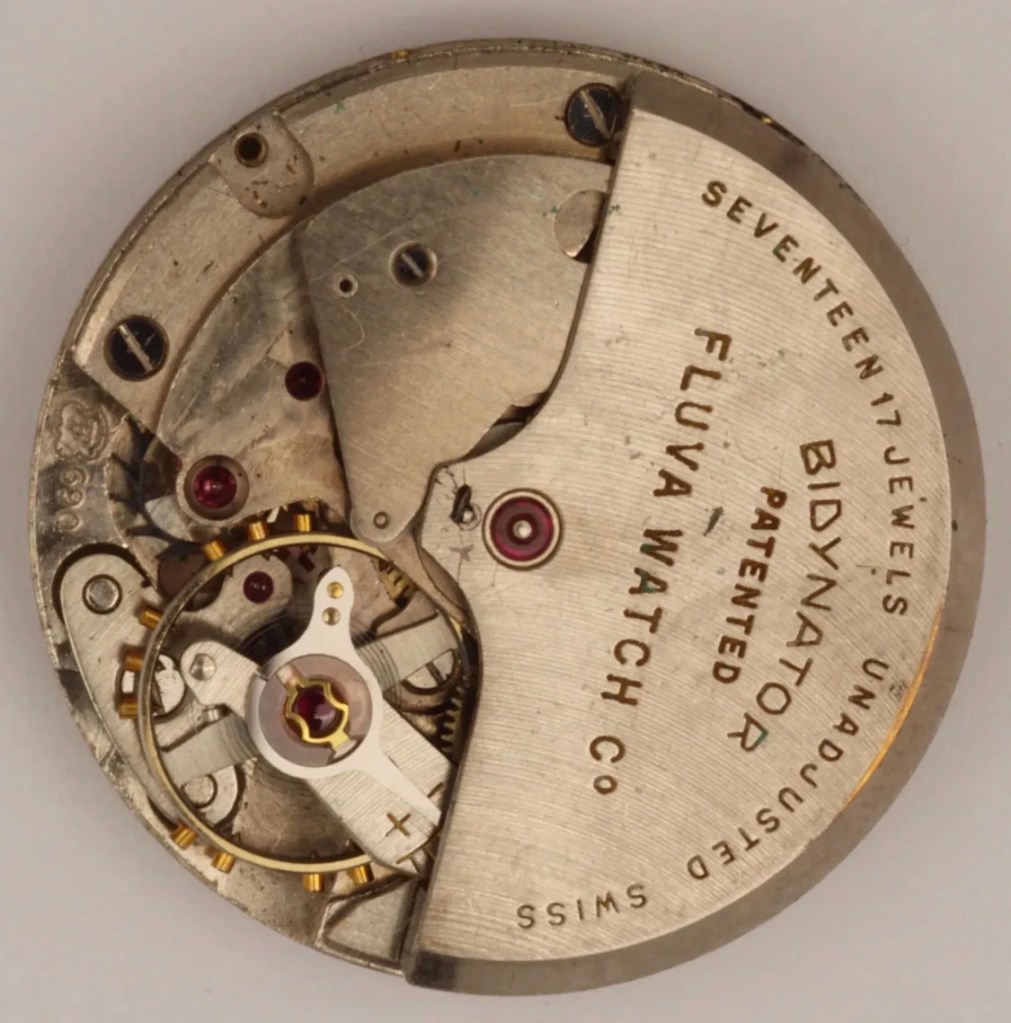
Felsa was a Swiss watch movement manufacturer founded in Grenchen in 1918 and became part of Ebauches SA (ESA) in 1928. ESA was a holding company for Swiss watch movement manufacturers from 1926, becoming the main movement unit of ASUAG in 1931 until it was merged to become the modern ETA between 1979 and 1985 (it’s very complicated…).
Felsa really jumped into prominence in the 1930s; designer Friedrich Meyer patented an automatic winding mechanism in 1942. The Cal.410 and Cal.380 (ladies calibre) were known as Bidynators – the brand name that this series adopted. Compared to the AS 1250, one of the earliest automatic movements from around the same time, the automatic mechanism is far better designed and more robust (and therefore much easier to take apart and put back together). The AS 1250 was a uni-directional automatic movement with a bumper system rather than a rotor doing a full rotation. Rolex, however, had developed a full rotor system and protected that movement with a patent. The Rolex rotor could only wind in one direction. The Felsa Bidynator was a bi-directional winding mechanism whereby the rotor winds the mainspring in both directions. As Felsa patented this mechanism, it forced competitors to develop different self-winding mechanisms. The early calibres were only produced for a short while as World War II delayed production and development, in 1947 the Cal.690 was introduced which improved on certain aspects of the mechanism. The Bidynator was sold to many different watch companies and was wildly successful and Felsa was able to build many variants off the 690 base.

So, the 690, Dr Ranfft gives us the following:
11.5”’, Dm= 26.0mm, Do= 26.3mm
H= 5.85mm
F= 1.6mm
T= 2.1mm
17/18/21/25 jewels
f = 18000 A/h
power reserve 44h
How is this one holding up? Pretty well… I’m getting over 24 hours of power reserve if I let it run dry. I wound it a handful of times the other day, left it around 18 hours, still going, hadn’t dropped a beat. I cannot fault this watch at all.
These movements are supposed to have a distinctive ratchet clicking sound as they wind that I’m not picking up, but honestly, when I hold this watch to my ears the ticking is not particularly loud either, so it might be that the case design has enough dampening to prevent me hearing it. It is a solidly made little watch, that should be evident.
So, what would this be worth? I’ll be very honest, it is not worth a lot. Bidynators seem to be very common, appearing in so many random brands, big and small, which in itself is odd as to why I have not yet managed to pick one up in all my years. I think this was a serendipitous swipe, and almost definitely fueled by Greg who seemed to rave about his. I paid £24; I think that’s a fair price, even if this is a mere trifle. If this was a watch with sentimental value it would definitely be something worthy of repair for that aspect (probably £180-£200 for the repair), but it wouldn’t necessarily be one that I would actively seek to do so because it is not worth that much. It’s not like it has anything particularly cool about it (historically) like an ATP, or that the brand is particularly noteworthy, it’s a handsome little watch but that’s about it. Is that harsh? Probably, but come on, 90% of the article is about the movement, that is literally the only reason I’m talking about it.

 The Escapement Room
Talk about serendipity… I literally just bought nearly the same watch two weeks ago! Everything about the watch you have is identical to mine except for where I yours is branded “Fluva”, mine is branded “Army Air Force Exchange”… and since I’m active duty Air Force I couldn’t pass it up! I just dropped it off at my watchmaker because the seller on Chrono24 lied about it being serviced and keeps good time, when it was actually all dried out and wouldn’t wind. So I am a little worried about the cost and time to fix it depending on available of parts. I know it’s probably not worth it, but for me from a military history standpoint, it’s worth it to me. Also, I borrowed a friend’s Geiger counter and it’s still hot!
LikeLike
Serendipity indeed – the style of watch and movement are relatively common in terms of period, but if your watchmaker can source parts then it should turn into a nice little piece with some sentimentality attached. As you have seen – “heat” is an issue for pieces of this nature. Radium paint has a half life of around 1600 years, I believe, so the paint itself will give out before the radium, but it does leave some risk. I hope you get yours sorted – let us know how you get on…
LikeLike
I am down to three Bidynators: an Enicar and a Bulova Watertite “P” (415) and an Altus (690). It is a remarkable early automatic movement.
LikeLike
Dear Chris
Thank you for your amazing note. I am writing to inquire about a vintage Swiss watch that I have in my possession. The watch movement is marked “25 jewels” and “unadjusted Swiss.” It also says “Bidynator Patented.”
There is no brand name on the watch’s motor, and there is no brand or company name on the watch face or the metal frame on the back of the watch.
I have been researching this watch, and it appears that it may have been one of the experimental watches made by the manufacturer Friedrich Meyer.
I am hoping that you can provide me with more information about this watch, such as its manufacturer, age, and value. I would also like to know how to best care for this watch.
Thank you for your time and expertise.
Yours sincerely
Hamid
LikeLike
I am not sure what more I could bring to the table. Unfortunately there are many reasons why the rotor may not have a brand name on them… vintage is usually about completing a jigsaw where sometimes the picture is never there, or not matching what is on the box, missing pieces, and in some cases a table to even put the puzzle on.
There are cases where the “brand” did not add their name to the ébauche. A 25J Felsa is not as common, but not necessarily experimental. The model number for the ébauche will be on the plate under the dial, usually under the balance wheel, but may involve deconstructing the watch to find. If it’s working, don’t do that, it’s not worth the hassle.
Sterile dials are common, but do not help. I have a sterile Vertex with a stencilled numeral font from 1936 which is uncommon for a Vertex, but the crown is the giveaway cosmetically, so perhaps there is something else you could use as a clue. What is the inside of the case inscribed with, are there stamps or markings?
It will probably be late 40s to mid-50s, but that is an educated guess. I have nothing really to go on.
Do you have a watchmaker/repairer you use? If not, I would find a good one near to you that can assist you with a decent service. That’s the best thing for your watch, especially if you plan to wear it. Keep it clean, wipe off any moisture post wear, don’t get it wet wet (rain or a splash is inevitable), and don’t be rough with it… you can wear it like most other watches, but it is an antique.
LikeLike
Dear Chris Thank you for your time and reply.I am sending you a photo of the front, back, and movement of the watch, and a video link of the movement running. There is no brand name on the watch, the back, or even the engine of the watch, and it is interesting that this Felsa 1560, Bidynator 25 Jewiels which was considered a masterpiece in its time, is placed inside an unmarked case. The watch works, but it lags about 10 minutes a day behind the set time, which definitely needs service and lubrication. Although I am not in good financial condition, I would be happy to introduce someone to me who can service it, because I think I have a piece of the history of the watchmaking industry on my hands.
Best regards
Hamid
LikeLike