

For those of us fortunate enough to have met our grandparents, we know that as one ages, one becomes more like a child: more fragile and more dependent. Our track and field grandfathers struggled to get to the post box. Our yoga instructor grandmothers couldn’t bend down anymore.
Most things deteriorate with age. Cars are a good example. Park even the most robust automobile for ten years and all of the rubber and plastic parts will have perished. Houses slowly lose their homeliness (i.e. the bloody window insulation stuff deteriorates making one’s bedroom feel like the Antarctic) after many decades. The list goes on.
It would then be logical to assume that vintage watches are frail and dainty. Most people do.
Nonsense.
In fact, older cars are better (for me, at least) than newer cars, because they don’t suffer from planned obsolescence. Older houses are made of bricks and mortar and bones and the tears of the damned, thus stay standing up for longer, plus they were designed by architects who could use more tools than a ruler. The key in all of this is maintenance. An old car will be a headache if you don’t maintain it properly. Think fuel additives and explaining to your girlfriend that the “choke” button doesn’t do what she thinks it does. A lot of times it is more effort, but the rewards are great.
So, do vintage watches require more frequent servicing? Yes and no. Yes if the servicing is done poorly or with natural lubricants. No if the watch is serviced properly with modern lubricants. Modern natural oils, Moebius 8000 is an example, which I use, because it’s the only oil readily available to me and is also relatively affordable, are much better than old natural oils. Sure, Moebius 8000 has a shelf life and will definitely not last forever, but it is still very good. Moebius 9010 is the synthetic equivalent of 8000, which means it will last longer and be a little bit more resilient.
Movement design also plays a role. A lot of Omega movements were engineered to be thin and cutting-edge, meaning that something like a shot rotor bearing can cause a lot of damage. Parts aren’t always common. Compare that with something like an ETA 2452 or FE 140, which didn’t place the same sort of emphasis on making everything thin. The ETA and FE movements can last forever, even at the hands of clumsy watchmakers. Thicker pivots and larger tolerances mean that the repairman (use more gender-neutral language – editor) doesn’t have to be a literal machine to work on them. You might find what I’ve just said surprising, but a well-maintained basic ébauche is more durable than an Omega or other luxury brand movement with dubious history.
Brand names mean a lot here. Many people think that vintage watches are frail because they stretch their budget and buy cheap vintage luxury watches. Vintage watches aren’t poorly made, you just bought the cheapest Omega (it really sounds like I’m picking on Omega, but unfortunately the brand is a good example for many phenomena discussed here) you could get your hands on and found out the hard way that there is nothing special or luxurious about the 10xx movements. That’s not directed to anyone, but it’s unfortunately a shoe that fits too many novice collectors.
Modern technology allows the manufacturer to put extremely tight tolerances on everything, pushing materials to their limits. They don’t always do that, because it’s bloody expensive, but they undoubtedly make use of the technology afforded to them. Sixty years ago, tolerances couldn’t be so tight. Sixty years ago, independent shops fixed watches, not just the manufacturer-approved watchmaker. This means that older movements are oftentimes more serviceable. Look at this 1940s Cyma:
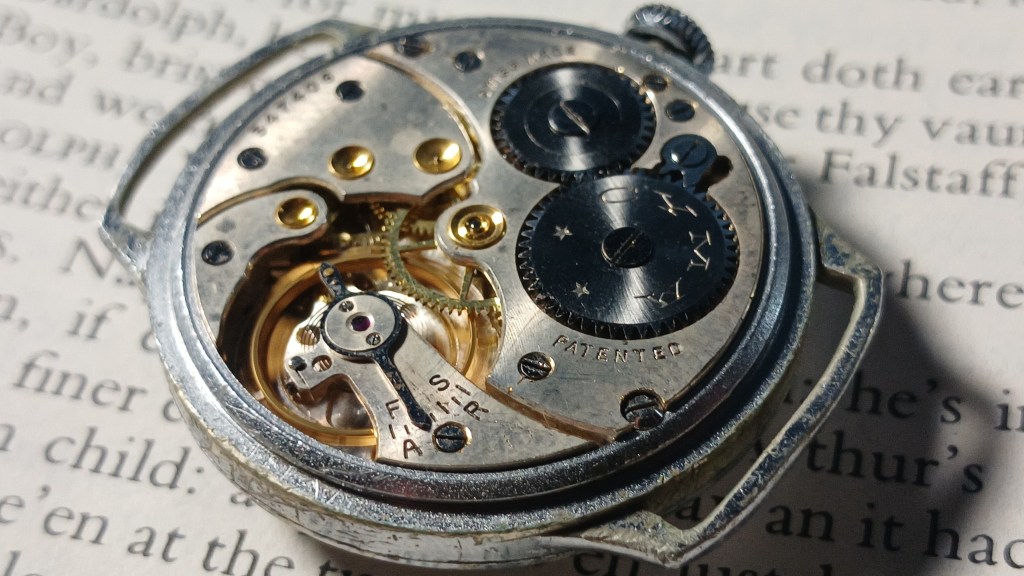
That’s a cock for the escape wheel. The escape wheel is usually the one that gives the most trouble when aligning the pivots for a train wheel bridge, so this feature is very merciful on the watchmaker, important for when your brand value depends on what the watchmaker tells his customers. You want the watchmaker to talk positively. You want him to say to prospective buyers “Cyma watches are good, I’ve worked on a few and they aren’t too much trouble.” Today, marketing happens on Instagram and the like, not by word of mouth of repairmenwomen.
Staying with the Cyma example of mine, it runs excellently, especially considering that it’s likely turning eighty or ninety soon. I suspect it’s to do with the tolerances and lubricants. 1940s oils were worse than nothing compared to what we have today. Moebius 8000 brought mine to life; clearly it was designed to operate within the limits of lubricants available at the time. My Cyma is not the pinnacle of robustness, however, due to the lack of shock protection. Most movements post-1948 have some sort of shock system in place.
So what’s the big idea? Where does the (according to myself, at least) misconception that vintage watches are fragile come from? Bad experience, exaggeration, user error, confirmation bias, et cetera. Look long enough and you’ll see that modern watches are unreliable too. Look at Tudor and Seiko quality control. There are fairytales and nightmares alike. The same is true for vintage.
I’m simply stating my experience as a collector and repairtheythem. I have worn vintage watches on motorcycles, when buffing cars and when using a power grinder to cut concrete lintels. I could probably think of more vigorous activities if I could be bothered to. If you’re a new vintage collector, stop being so scared. Unless the watch is a hundred and onety two and three years old, it won’t break when you look at it, provided it hasn’t been abused for decades or repaired by ham-fisted feral apes.
Vintage watches can survive and can be worn. Stop being dramatic.


I get the feeling that the “ooh scary, vintage watch so delicate” people are they types that pay others to change light bulbs and the like. It’s springs and gears. Most of these things are pretty mass-produced and standardized. It’s not like we’re dealing with rare handmade one-offs here.
I’ve said it before, but if I can have some late 1800’s key-wound pocket watch by a long-defunct French watchmaker brought back to life and tip-top shape for less than I assume it’s worth, I don’t really understand the trepidation some have over some 1970’s Seiko or the like.
“Oh I won’t be able to drag the crystal across concrete and toss the watch in the shower and oh gee golly I might need to actually speak to a watchmaker, er repairman, instead of plunking my credit card into a website and mailing the watch to da official factory overcharge service someday!” Well, if you’re the sucker that buys the extended warranty, the tepid challenge of vintage horology might be too much for you.
LikeLiked by 1 person
Very well said!
LikeLike
I wear my vintage watches more than my modern watches. They are tougher than most people give them credit for. I do, however, avoid the rain when wearing vintage. HOWEVER, it’s not because vintage can’t handle a little rain. I’m more worried about the leather strap than the watch with rain. Those on mesh or steel bracelet I’m less sensitive about.
LikeLiked by 1 person