

I’m on record as saying I don’t believe in saving for watches. I’ve written about this exhaustively in various online fora. But as this is relevant to this post, I’ll sum it up really quickly here.
How I determine whether or not I can afford a watch is by looking at my overall economic health. If the cost of a watch won’t be missed anytime soon, I buy the watch. Just because I have the money in my bank account does not automatically mean I can afford the watch. I have to consider how losing said amount will impact my life. As an example, if a watch costs 100 dollars and I have 500 dollars in my bank account, I can’t afford said watch because it is a significant drain. That 100 dollars could spell the difference between making next month’s rent and homelessness.
No problem, you might say, save up the 100 dollars and get that watch at a later time. “Ah,” I reply smugly, lighting up a cigarette, pausing for a few seconds for effect and add, “I don’t believe in saving for watches. It’s a mug’s game.”
I don’t save for watches. Instead, I wait until my economic situation has somehow improved so that that 100 dollars would be insignificant and not worrisome. Saving money is for priorities and watches–while I enjoy them–are never that. I save for my kid’s education, for family vacations, for retirement, for a new car, maybe even for a new laptop. You know, things that mean something in the real world. Those things deserve to have a budget and it’s fine to move money around and crunch some numbers to make them work. Watches are frivolous, I don’t move my life around to accommodate a new watch that I simply can’t afford.
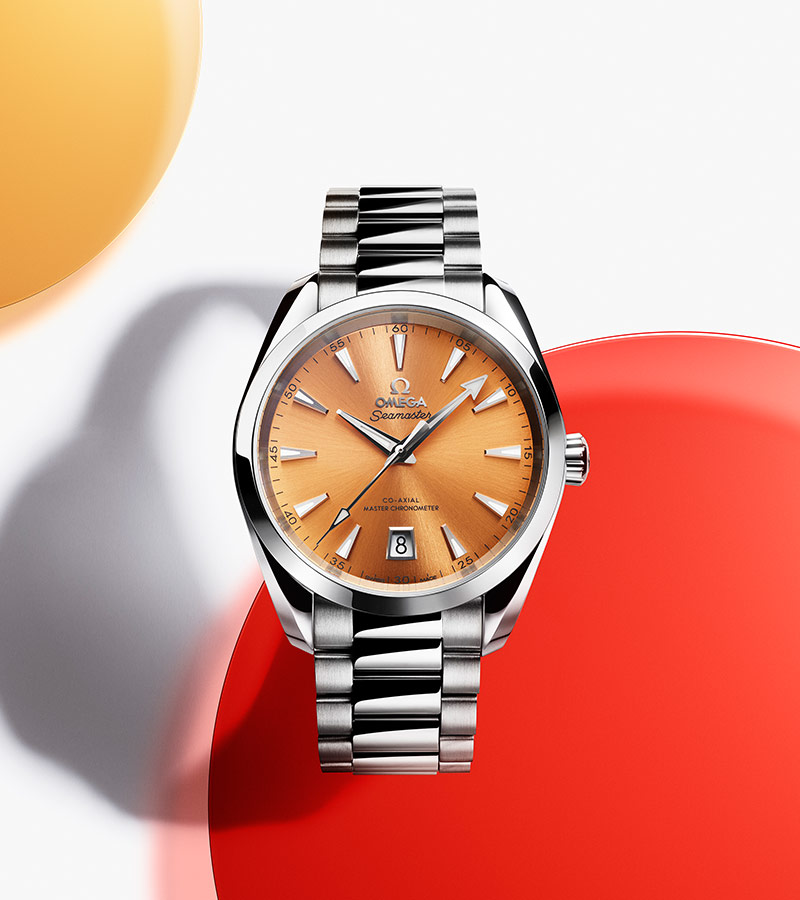
I will admit that this approach is very limiting. If I buy only what I can pay for right now, I might miss out on some really cool pieces that if I only save for a year or two I could easily get. What about those? Well, I would argue that if it takes me twelve actual months to save up for a watch, there are other places or things that money could be used for. How many steak dinners or weekend getaways do I need to skip to get that Omega Aqua Terra? I would love me some Aqua Terra, especially the 38mm saffron dial, but not enough to sacrifice the little pleasures of life.
Which brings me to yet another admittedly counter-intuitive strategy I have with watch purchases. I never sleep on a watch before buying. I only do impulse purchases. Sigh. I know. I’m vile.
Okay. I exaggerate. It’s not never sleep on it and it’s not only do impulse. There have been watches that I do sleep on before buying. Maybe even several nights. But you get the idea. Immediate, rather than prolonged agony.
And I have given some purchases their requisite thinking over. But the few and far in between well-thought out, heavily researched purchases have me convinced that impulse is the way to go. Carpe diem. Or maybe carpe tempus? Seize the time?
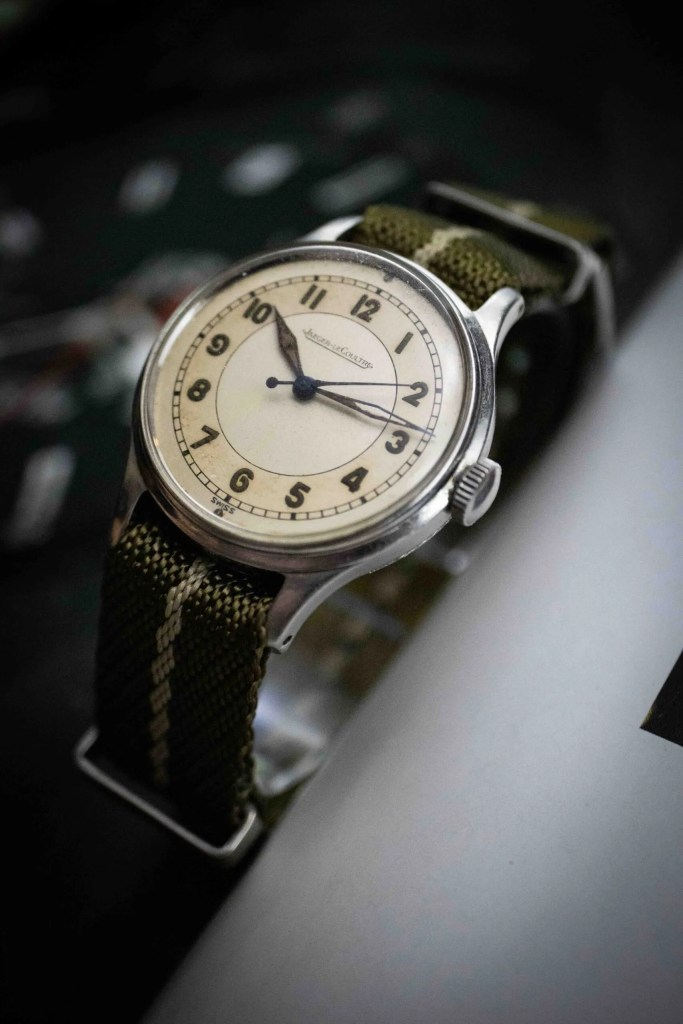
I find that the watches that matter the most in my collection, that I am most impressed by (even if no one else seem to be), are all impulse buys. They are the watches that upon first seeing made me feel something beyond, “Oh, nice watch.” And these are the watches that I am still amazed by every time I see them in my watch box. I got lucky, I would tell myself, smiling as I look at them, feeling proud of my undeniable perspicacity and good taste. The 1940s Jaeger LeCoultre P478 Royal Air Forces WWII Military Watch comes to mind:
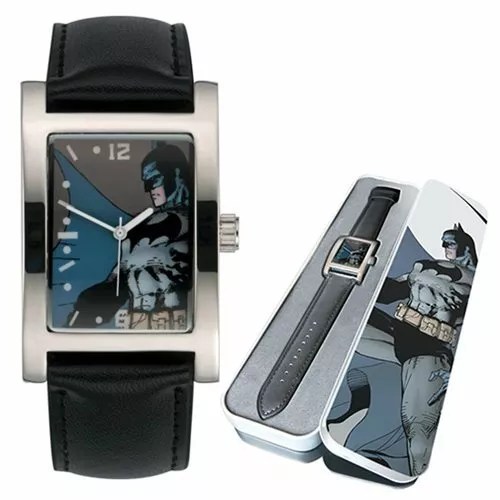
It’s true that they haven’t all been gems, these impulse purchases. With some watches, I am embarrassed by my stupidity and wonder what I had been smoking at the time I decided. For instance, I like Batman, I like watches. This one should’ve been a no-brainer. I bought it, never wore it.
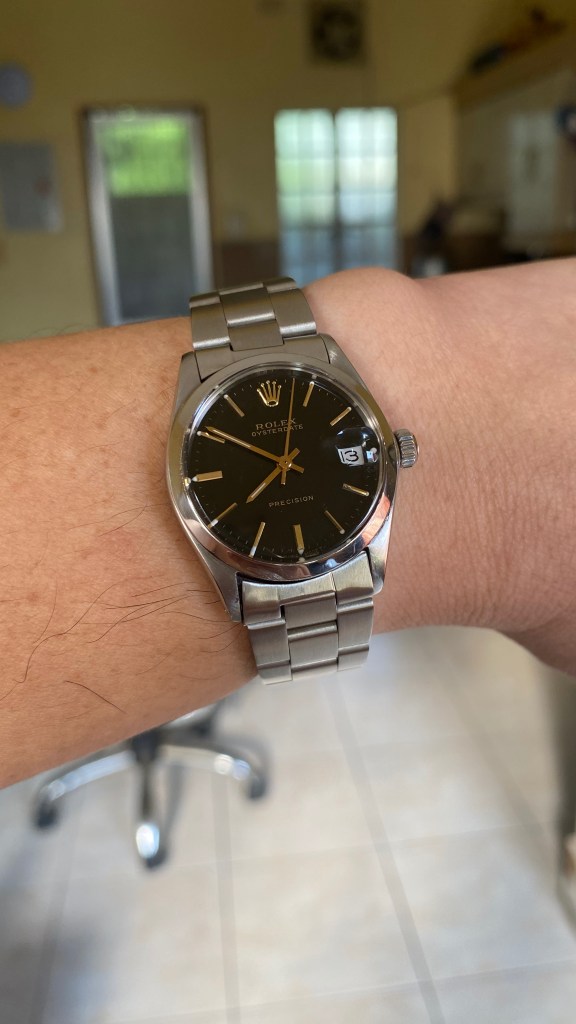
However, the thing is, while buying on impulse can be hit-and-miss, all my carefully selected, sleep-on-it purchases had all been misses. Example, the 1959 Rolex Oysterdate wasn’t an impulse buy. I gave it the right amount (I think) of time to percolate in my head, looking at the details, compared prices online. I probably spent two months just going over everything, even the size. It’s 30.5mm. I haven’t had any real problems with the size before. I have a number of 30mm watches to date. No problems whatsoever. I finally bought the watch and I tried to love it. I really did. I ended up trading it with the JLC P478. There was just something about it that didn’t sit well despite having studied it for months.
Of course no watch is perfect. Of course. It will never be perfect. You will either learn to live with the imperfections or you won’t, ever. As such, all things being equal I see no point in waiting to make a decision. No amount of research will make me forgive the imperfections if they are unacceptable. In fact, the research may actually add to unmet expectations. The more you wait or think about a purchase, the more you build it up in your head, the more unreasonable your expectations may become.
At the start, a watch might just be another watch. But the more you stall, wait it out, compare with other watches, think deeply about the rightness of its size, what features make sense for that price point, materials, etc., the more these watches end up disappointing. It stops being just another watch and starts becoming the answer to the question of life, the universe, and everything.
I don’t have any data on this but I wonder how many hours of heavy contemplation are actually wasted on watches that end up not being bought after all. Because what’s really happening (I think) is that people aren’t thinking about reasons to buy the watch, they’re looking for excuses not to buy the watch. Whereas, when you impulse buy, you’re addressing an urge as it emerges. A decision made given the information you had at the time, which is almost none. So, expectations are lower. And because you didn’t overthink things upon purchase, you have more magnanimity over the imperfections. At least, that’s the case with me.
This is where my “don’t save for watches” comes into play, creating the perfect (or close to perfect) buying experience. The watch I like right now, which I can afford to buy right now given my overall financial health, a watch that could be painful money-wise but doesn’t break the bank, is purchased with little to no expectations. What can go wrong?
Of course many things can go wrong. Of course. I might end up buying a lemon. There’s that risk. Good news is, because I didn’t save up for it, it’s not going to impact my life as much as if I cut down on my daily Starbucks coffee, sacrificed my Netflix account, changed my lifestyle, etc. It’s just another watch. Oh well. Next.
But whatever mistakes I make using this strategy, I think they’re less damaging than the mistakes I can make when I over-research a watch and save up for it. Can you imagine the disappointment? I saved up for months for this crap, all that research and trying out at the AD and consulting the Internet, and for whatever reason it doesn’t live up to (my unfair) expectations. Now I’m out of the money that, once again, I worked hard to save. Double disappointment. Or it might exactly be as advertised on the tin, no imperfections. But because I built it up in my head so much, waiting and waiting and waiting until I was ready, how can I then be sure it will be as magical upon purchase as when the idea of it first entered my head howsoever many months ago?
Obviously I’m not saying this approach will work on everyone. It might not even work on anyone but me. But, you know, maybe it can?
I believe that the happiness we can get from consumerism (and yes we can get happy even if it’s fleeting) is inversely proportionate to how big a deal we make out of it in the acquisition. The bigger the deal, the less it can feel fulfilling. That Louis Vuitton bag is a great bag. Can you afford it? Great. You’re happy for a full day upon buying it. You can’t afford it but believe it will change your life so you save for it? Jesus. Good luck on that one. See, a bag isn’t supposed to make you happy for the rest of your life. That’s too much to expect from a bag. It’s easier not to expect the second coming from a bag if said bag didn’t mean your life will be in shambles if you lose it.
Do not mistake this for the happiness you get from living your life. Consumerism is not the same as the happiness you get from working hard on something. Your success in your professional or personal life is proportionate to the hard work you put in.
Don’t compare your watch with your life. It’s a small thing, a toy, a nothing. Despite what the snobs say, it has no soul, mechanical or otherwise. Your life has a soul, whatever form that might take shape as in your head based on whatever god or non-god you might believe in. That soul requires work and love and energy and patience. Put all your energies there instead and just buy the goddamn watch and be done with it.
Now so much I know that things just don’t grow
If you don’t bless them with your patience
— Emmylou, First Aid Kit

 The Escapement Room
Amen brother! It took me a few years to realize what you so eloquently laid out in this article, but I think I’m finally at this point. I’m Catholic and I should not be buying luxury goods, there are so many better uses for my money to help others. I used to save up some “slush” money as my wife and I call the little bit we give each other for fun each month, and I would save up for the next watch, buy, sell, make money, lose money, new, pre-owned, vintage, etc. It’s been fun, and disappointing but is definitely feeling like Jeff McMahon says, being on the “hamster wheel of crazy.” What I realize now was how you’ve put it before, I was sowing my horological oats. I’m at the point now where I’ve learned a ton, I know what I like and don’t like, and no matter what new watch comes into my collection, it’ll never be as good as the Moonwatch I own that I bought as a military retirement gift 2 years ago and have made family memories with. Now I got rid of all my other watches that were worth anything, and am taking the tact to keep a watch fund going slowly over time, so when the occasion or special reason in my life comes, I can do what you said… just go out spontaneously and buy a watch that fits that budget without putting too much pressure on it. It’ll mean more to me for sentimental reasons than for just buying any old watch just because I have money to spend. I’ll still be saving up for something, someday, but it is less likely to disappoint me because it wouldn’t be able the watch, it would be about the event that I bought it for to remember. Or maybe spend the money on a crappy old car. Lol
LikeLike
Watch weirdos really need to read this, learn this, live this. The number of people that I read claiming that the peak of their existence will be when they’ve scraped together enough shekels to get (insert commodity grade current production watch model here) and ascend to some new level of satisfaction is perplexing. Evolution is slow. If you didn’t love the last watch you got, chances are the next one won’t fare much better. And none of this matters anyway.
LikeLike