
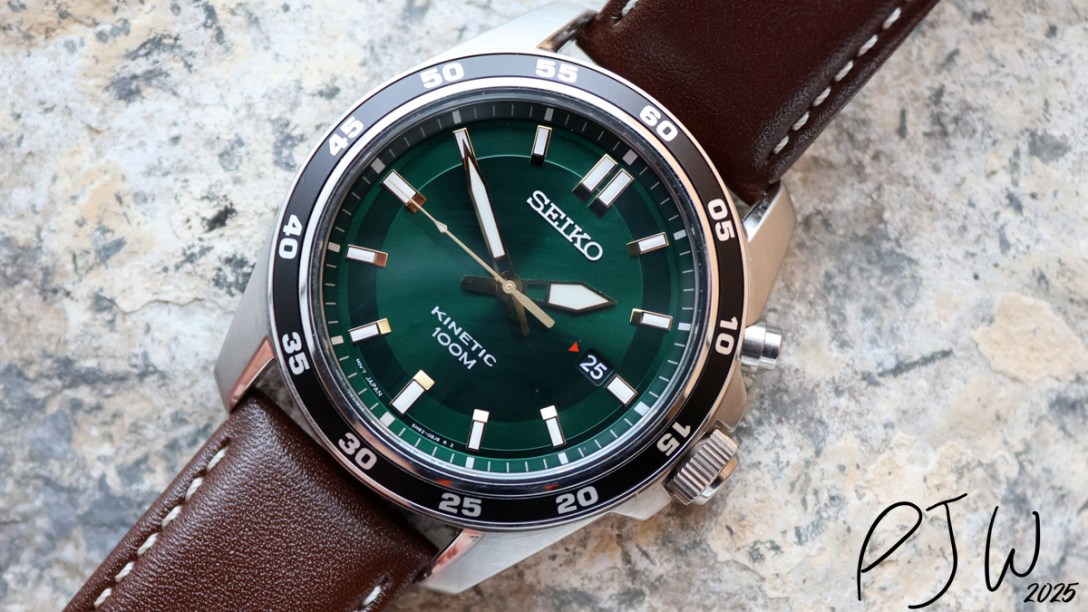
A few months back, my good buddy Tim Johnson gave me his Seiko Kinetic watch. The Kinetic line was Seiko’s attempt at a Quartz watch that wouldn’t need a battery change every few years. However, it entered the market at a weird time, and has all of the issues of a mechanical watch combined with those from quartz watches. Despite the downsides, it is an interesting movement, which leads into this article. What was the Kinetic movement, and how does it work?
An Abbreviated History of the Kinetic Movement
Seiko’s Kinetic movement dates back to the mid-1980s. It was introduced as an “automatic quartz watch”, as it uses an automatic rotor to charge the battery powered movement. By the 1990s, Seiko changed the name to the Kinetic, and there have been a lot of updates to the movement over the last 3 decades. Some updates include:
- Longer battery life
- A chronograph complication
- Manual winding
At time of writing (May 2025), it seems that Seiko has discontinued the movement, and the line of Kinetic watches. With the rise of solar watches and the return of a lot of normal mechanical watches, I can see why the Kinetic has gotten the boot. There are still some models that you can find as NOS (like the one I’m showing here), but as a whole, they’re gone. I’ll talk on it later, but servicing these can be a mess too.
For a full history of the movement, I’d recommend this article from STRAPCODE.
So the Kinetic movement (called the “emotional technology” in Seiko’s literature) is a quartz watch that you charge like an automatic. How does that work?
How It Works
Fundamentally, the Kinetic works like a crank-flashlight, and acts like a hybrid car in use.
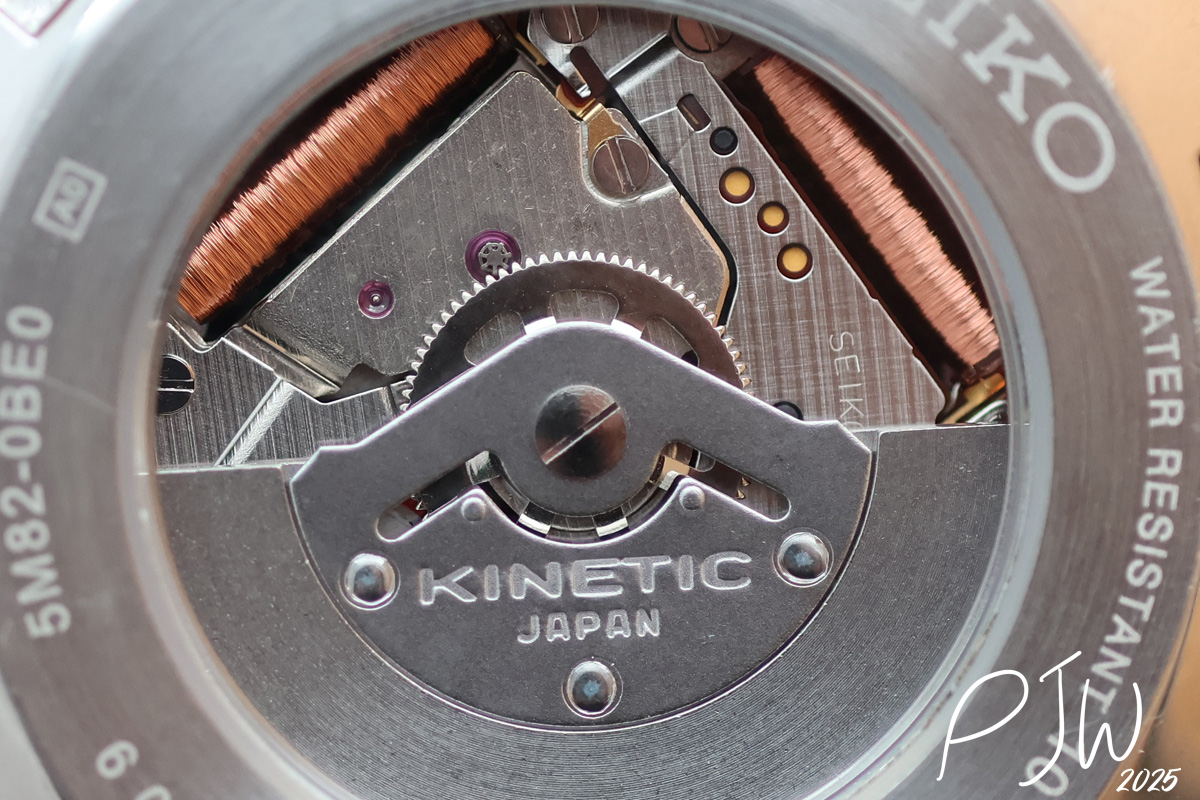
The movement has a rotor, which can swing in either direction. When wearing the watch (or shaking it), the rotor spins, which creates a small magnetic field. That field generates some electricity (using the two copper spools as inductors), which charges a capacitor (the modern Kinetics use a reachable battery, but Seiko still calls it a capacitor) on the movement. For the purposes of the article, I’ll call it a battery, despite what Seiko calls it. Capacitors and batteries function differently, despite both being things that hold electricity.
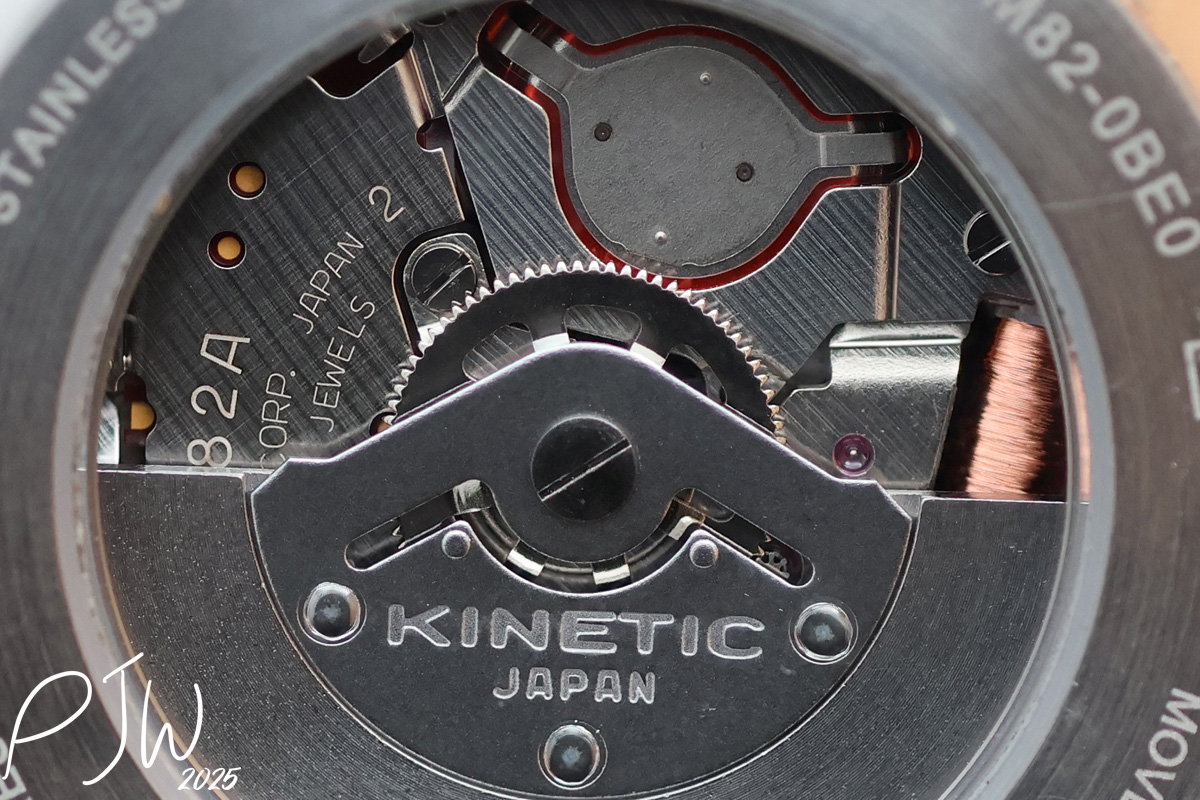
The power from the battery then runs the quartz part of the movement, which gives the watch the timekeeping and date function.
The early Kinetics used a proper capacitor, which held a pretty anemic charge (about 3 days). They quickly changed to lithium-ion (Li-Ion) batteries, which hold a better charge. Seiko would replace a capacitor with the Li-Ion when a watch was serviced in the past. However, those have their own issues too.
Which Kinetic movement do I have?
The Seiko 5M82A Movement
The movement in the watch that I’ve got is rated for up to 6 months of battery power when fully charged. However, it takes A LOT of rotor movement to get to that level of charge. This movement also lacks a manual wind, so if you wanna charge it, you’ve gotta shake it up!
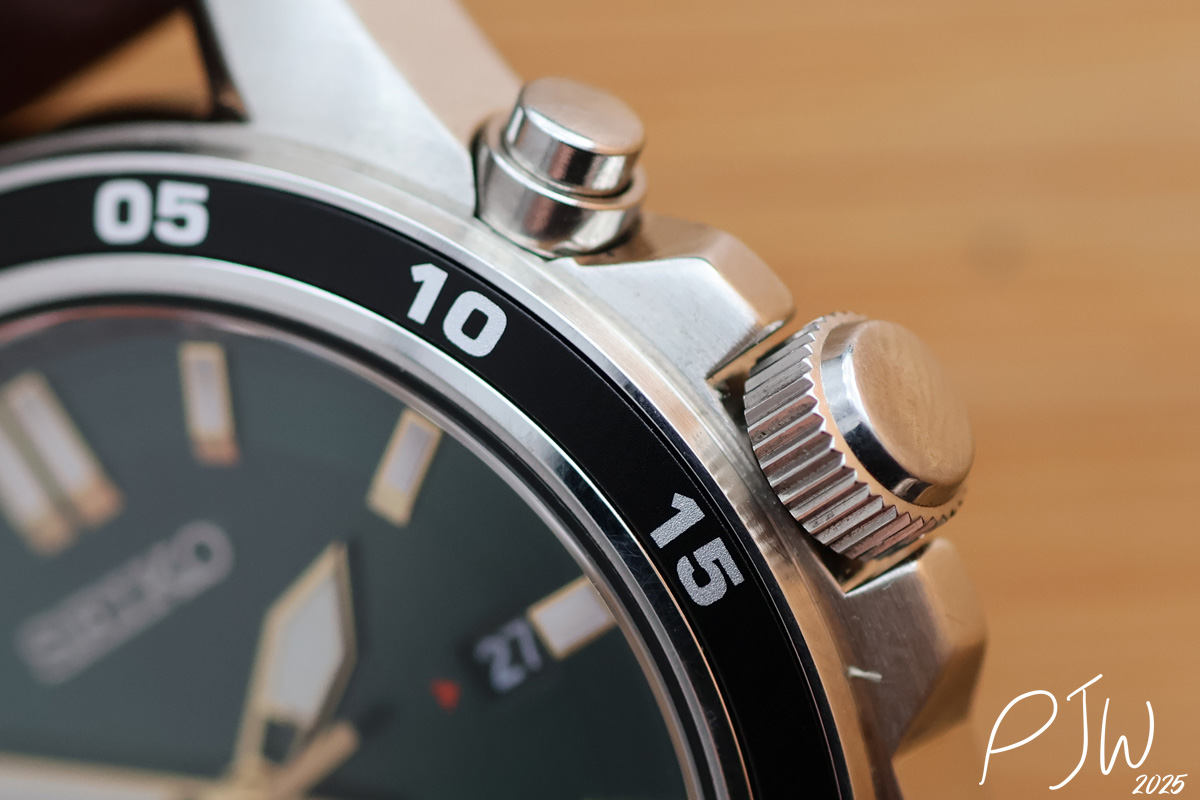
To check the charge, you press the pusher above the crown. The second hand will swing clockwise, and depending on how far it goes, that’s how much charge you have. A 5 second jump is a day’s worth of power, 10 seconds is two days, 20 seconds is a week, and 30 seconds is six months. This seems pretty random to me, but it’s how Seiko calculates the power.
Once the movement catches up to the change in time (5-10 seconds), it’ll get ticking again. This does not change the time on the watch, as the quartz movement is still tracking time, regardless of what the hands are doing.
If you want to see the manual for the movement (as many of us nerds would), that it linked here.
With the advent of solar quartz movements (Casios, the Citizen Eco-Drive, and Seiko’s own movements), the Kinetic has fallen to the wayside. What’s the big deal with them now?
Why Kinetic Exists
Seiko did not put out a specific, targeted reason to making this movement when it released in the 1980s. However, I think the Kinetic movement was made to try and make it easier to get into quartz watches, especially during the quartz crisis. I imagine that some folks were worried about needing frequent battery changes on new watches, but the Kinetic didn’t need that.
The watch powers itself, as long as the battery is good. Rather than an battery change every few years (or every year for many early quartz watches), the Kinetic would be good for close to a decade of use. You did have to wear it to keep it charged, but that’s easy enough to do.
Well, there is a massive downside to the Kinetic now, and that is that battery.
Kinetic Movement Woes
Since Seiko discontinued the Kinetic, it’s gotten harder to service the watches. Rather than doing a conventional battery swap, you need to replace the proprietary rechargeable battery. These batteries aren’t impossible to find, but they’ve got an issue related to being Li-Ion batteries.

I’m sure that you’ve heard about range anxiety with electric cars, and that’s kind of an issue with the Kinetic movement too. Li-Ion batteries don’t like to be at very low charge, or maximum charge. They kind of want to hang out in the sweet spot, of a 40-80% charge range. The issue here is that a lot of the replacement LI-Ion batteries for the Kinetic movements are holding very close to no charge when sitting in a warehouse. As such, the replacement batteries are not lasting very long, with many reports of 18 to 24 months of life out of new batteries that have been sitting.
Between the proprietary design and cost of the batteries (about $18-$26 a pop), these are hard watches to keep running. On top of that, the battery swap is a bit harder to do than on a standard quartz watch, as you need to remove the rotor, and a few other parts to get down to the battery. Your local watchmaker probably can’t do a battery swap unless you supply the battery, and even then, it’s likely going to be a good chunk of cost to have them do it.
Despite what you may hear, you can swap the battery in a Kinetic. However, it’s not going to be easy or cheap to do. How’s the rest of the watch?
The Watch Itself

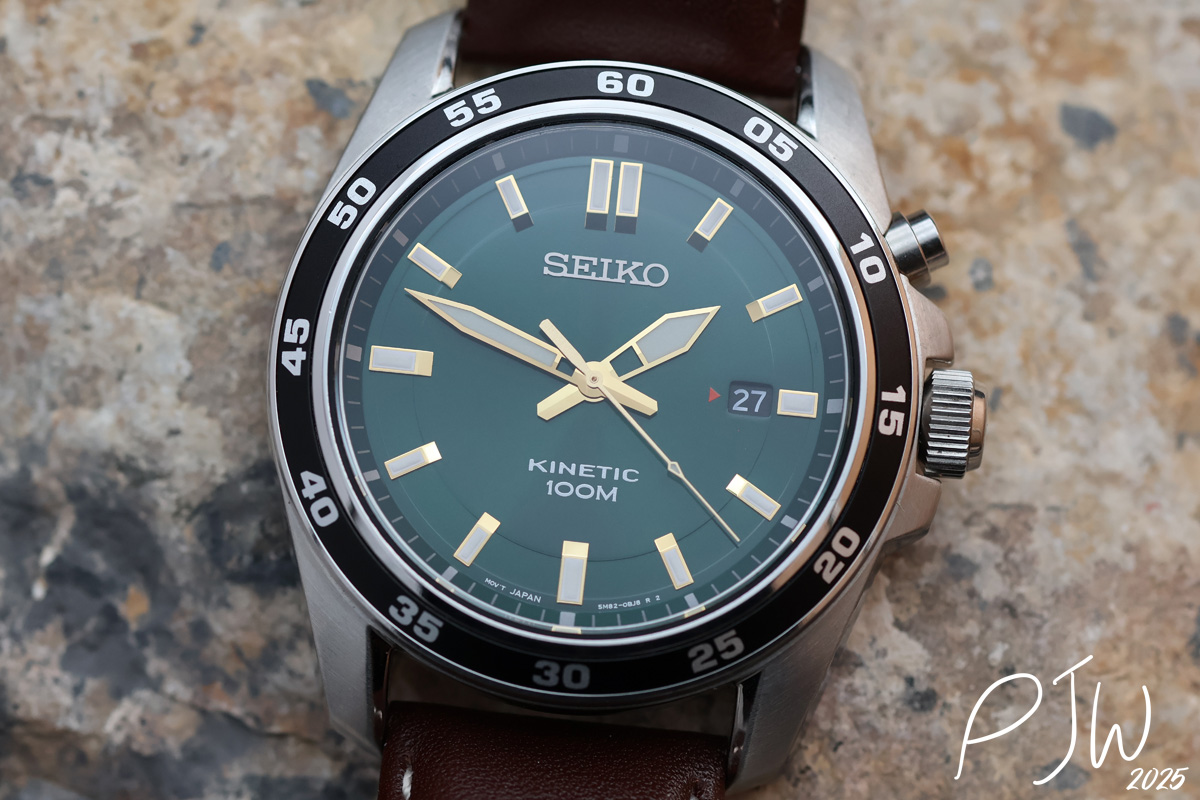
While this isn’t a review, I’d be remiss if I didn’t talk about the watch itself. The Seiko SKA791P1 is a 43mm wide watch, with a fixed bezel, green dial, and brown leather strap. It’s got a simple push-pull crown, a date complication, and 100m of water resistance. When new, these ran about $175, but now they’re about double that due to the Kinetics being discontinued.
It’s not really my kind of watch, but it’s not a bad looking one either.
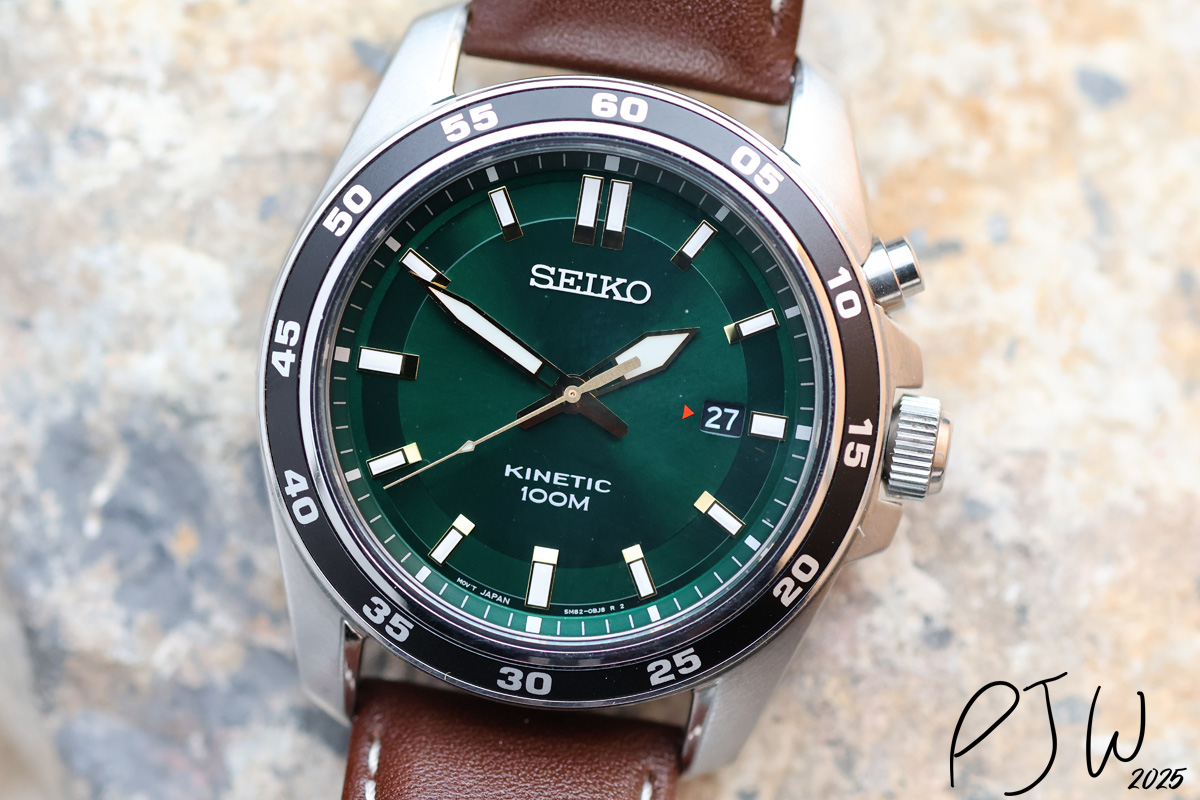
The dial reminds me of the Omega pie-pan Constellations, and looks pretty great. This color of green is reflective and dark, and works well on the size of the watch. The hands and indices are large, which leads to a legible display. We’ve got a mineral crystal (it’s Seiko, you ain’t getting sapphire), and it’s pretty clear to look though.

They skimped on the crystal, but not on the lume. It’s Seiko-diver quality, which means it’s fantastic. I don’t like the bezel (it doesn’t really do anything), but I know that a lot of folks do like it. The little touch of red next to the date window is nice to have, as some contrast is handy.
All-in-all, this is a watch that is interesting due to the movement, and not the rest of it (at least to me).
The Verdict
The Seiko Kinetic movement is an interesting footnote in watches. Seiko made about 8-9 million watches with the movement over the last 40 years, but with solar quartz, I think it’s basically obsolete now. What do you think about the Seiko Kinetic movement?
If you’d like to check out my other works for The Escapement Room, follow this hyperlink. I can also be found at PrimerPeak, YouTube, and WatchCrunch.
If you want to see some video of this Kinetic watch, I’ve got that below!

 The Escapement Room
If you can wear one enough (like everyday or couple of days) it’ll stay adequately charged. But other than that they are a PITA. I’ve owned a few over the years but all are gone. It takes dogged determination and the patience of a saint to bring one back from a 1 day power reserve. There was a special charger available (from Seiko) for a time.
LikeLiked by 1 person
It’s certainly a hard watch to maintain if you’ve got more than one. The charger is a new thing to me, looks wild from what I’m seeing. Almost looks like a wireless charger for a cell phone.
LikeLike
nice write up Paul.
I remember the kinetics and was often tempted to one in the 80s and 90s. I think they were a step on the road to the holy grail of spring drive.
LikeLiked by 1 person
All roads lead to spring drive?
It’s a neat movement, and I could see the cool factor in the 80s/90s. Still, I think it’s a neat stepping stone for the movements that came after it.
LikeLike
I have the same watch from your review and I love it so far. I can keep it at the “6 month” charge by wearing once or twice a week with some “Seiko shaking” as well. I like to collect unusual movements like the Bulova Precisionist Jet Star, Seiko Mecaquartz NM-31, Casio Lineage with atomic clock synch, Omega Speedmaster with 9 complications, Seiko Presage with power reserve indicator 4R57 and this one fits right in!
LikeLike
My Pulsar [Seiko] Kinetic watch hasn’t missed a beat in 10½ years. Brilliant. Definitely not inbuilt obsolescence!
Sorry if it has been discontinued, but then I am not looking to replace it any time soon.
LikeLike