

Opinion is like a skanky mistress. Those who have them think they’re great and of some value. Everyone else look at your opinions (or your mistress) with contempt and suspicion. Gold-digging lowlife who isn’t good for you is the general consensus. But you yourself will fight to the death your “truths” as though they are based on Jesus’s last words before ascending to heaven. I’m an atheist, by the way–this is not relevant but I just thought I’d share that since I mentioned Jesus.
Anyway, I find it fascinating that, in this day and age, a lot of people can’t tell the difference between an opinion and a fact. I have seen people say that Japanese watches are better produced than Swiss watches, as if that’s a fact. I’m not saying it is or it isn’t. What I am firmly stating is that such an assertion is not a fact. Now, this is all fine and dandy for the most part. Everyone has an opinion after all. I’m not a proponent of disclaimers. They just make content clunky. Posts shouldn’t always be prefaced with “in my opinion” or “my two cents” or “I think” just to clarify.
The reader–you–have some responsibility in the dissection of content. You should be able to tell what is my opinion and what is a fact, not just based on what the words that I write but also the substance of my content. If I told you that mechanical watches are better than quartz, your spider sense should be tingling. You should able to discern that I’m expressing a “truth” that only applies to me. You can’t just tell me I’m wrong because of A, B, C, and D. I shouldn’t have to clarify my statement with “this is just for me”. Because, well, look at the assertion: Mechanical watches are better than quartz. It may look like it’s a factual statement but it’s really not. Nothing in that thought is factual. Better is a word that cannot be used objectively. So it’s an opinion. I mean, what else is it?
I think a lot of people intentionally misunderstand content because they already have in their head their own “truths” and anything that counters inadvertently offends. How dare you say that mechanical watches are better? That is snobbery. Cool your jets. I’m stating an opinion, which you can rightly so disagree with. And you might even have facts to back up your argument. But it’s still ultimately an opinion, no different than mine. If I say, for something to be considered a watch it can only be made out of stainless steel. That can’t possibly be an opinion. That’s a statement of fact. Erroneous yes. But I’m mainly talking about the sentence. The moon is made of cheese. That’s a statement of fact. It’s not true but it’s not an opinion. I made a factual assertion, rightly or wrong. Back to my example. You can point to watches that are made of other materials to prove that I just made an erroneous statement.
What am I getting at here? Facts and opinions are very distinct from each other, even without categorization. You don’t need “in my opinion” to detect an opinion. We shouldn’t confuse them. Same thing with the sender of the message. Sometimes I’m baffled by the way people state things as if they are facts when really they’re giving opinions. Patek Philippe has lost their way. That’s an opinion, not a fact. Patek Philippe just released a square watch–fact, not an opinion.
I have “truths” about watches that shouldn’t be perceived as truth. Some of them I don’t even know how to prove. But I do believe in them with the conviction of a young priest just coming out of the Rite of Ordination. And that’s alright. Everyone has these. I shouldn’t get crucified for them.
Here are a few:
Water resistance is a financial consideration, not a specification. By this, I mean, a Casio digital watch with a 50 meter water resistance is okay to swim with, not because it says 50 meters in the tin. It’s okay to swim with because it’s cheap enough that if it’s okay to risk swimming with it. If something goes wrong, you can buy a replacement at that very hour. An Omega Speedmaster with a similar water resistance is not okay for swimming, not because it can’t handle a dip in the shallow end of the pool but because the consequence of it getting water inside is grave and costly. Yes, the Speedmaster is designed to withstand a light swim but… yeah, no. Different people will obviously have different thresholds. One man’s Seamaster Professional 300M is another man’s Casio. I’ve met those people. It’s really infuriating how much they can afford the watches I want.
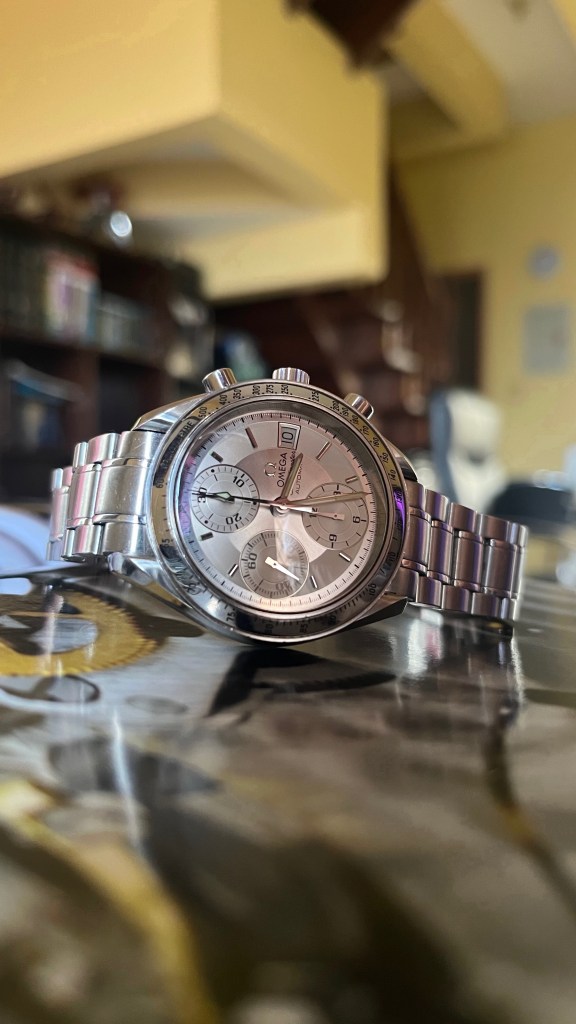
Speaking of money, your enjoyment in collecting hinges on whether or not you can afford the watches you actually like. Everyone keeps pushing Casio, Timex, etc. and they say these tell the same time as Rolex and JLC so why pay more? I think you pay more because you can afford them. And you “buy” the affordable because you have no choice in the matter. Yes, someone somewhere will say things like, “Not me. Even if I have the money, no way will I buy a watch that costs more than my car. A Seiko is just as good as a Tudor, maybe even better.” That’s their opinion, that is not fact. And this particular opinion is not based on the merit of the individual brand, it’s based on what they can or can’t afford.
To expound: Yes, you can enjoy Casio and Timex and all the other affordable watch brands, but only if those are the watches you like and that they’re not just substitute because the watches you really want are out of reach financially. I genuinely believe that majority of people would buy a more expensive brand if they could afford it. By afford, I don’t mean physically possessing the money. Affordability is one’s mental threshold for an item. I can buy a 100 USD burger. But I don’t think I’ll ever buy one of those. 100 USD is steak territory. A burger to me shouldn’t cost more than 20 USD. That’s my level of affordability. I can’t and won’t afford a 100 USD burger.
So, you like Timex or Seiko. Your mental threshold for how much they cost is within your budget, then you should get those brands. You’ll enjoy them. Truly enjoy them. If you’re buying a watch just because that’s all you can spend your money on, you won’t be happy.
To expound even further: I’m into vintage watches. I like specific brands but they are just out of my price range. Even if I get the same type of watch, with the same pedigree, from the same period, I will always find myself feeling discontent. I should just get the brand I like even if it’s more expensive.
Collecting watches is not without its cost.
Another “truth”: Impulsiveness defines the enthusiast, curation defines the collector. Man, this one might get me in trouble. I stopped buying watches in November. For personal and financial reasons. I’ve also been aggressively reducing my collection as well. I’m now down to fifteen pieces. I find myself feeling more of a collector than I did when I was buying left and right. See, now impulsivity is a clear indication that I care more about possession than the actual watches themselves. Before November I relished in the number of watches I have in my watchbox. But since I stopped buying, I started to carefully curate and figure out what pieces are worthwhile keeping. Those aren’t necessarily the most expensive, mind you. And now I feel like I’m a collector because I care more about the collection than the acquisition of new watches. I even stopped wearing them on a regular basis. I just know that if I wanted a specific watch for a specific event, I have that watch. The enthusiasm has morphed into something else.
There are other truths but I’ll spare you. These are just examples of unwavering beliefs that I have about watches. I don’t know that there is any way to prove or disprove any of these. All I know is that the longer I think or don’t think about watches, the more refined my ideas of what kind of watch guy I am. Refinement does not mean classier. It just means the removal of impure pretensions and being more honest.

 The Escapement Room
Absolutely love the post Sherwin!
LikeLike